

Clear Answers About ADHD, Learning Disorders, Autism & mental health
Psychological Testing for Children & Teens in Reston, Virginia
You're watching your child struggle, and you can't quite figure out why.
Your bright child reads slowly and avoids homework. Your teen spends all evening studying but gets grades that don't reflect their effort. Your child has frequent meltdowns or finds it hard to make friends.
You've tried different strategies. You've talked to teachers. You've wondered if this is just a phase or something more. You're exhausted from the worry, and your child is exhausted too.
Perhaps your child, teen, or college student …
Struggles to focus, gets distracted easily, or can't stay on task.
Takes much longer than classmates to finish homework.
Has trouble learning to read, write, or understand math.
Is falling behind in school, even with extra help and support.
Has frequent emotional ups and downs like frustration, anxiety, or sadness.
Finds it hard to make friends or feels confused in social situations.
you and your child deserve clear answers
A psychological evaluation will reveal why your child or teen is struggling and how to make it better.
As a licensed clinical psychologist, I provide in-depth psychological evaluations. These evaluations uncover your child's unique strengths, explain their challenges, and show you exactly what will help.
Many families come to me after years of trying different strategies without real answers. When you don't fully understand the problem, it's easy to waste time and money on strategies that don't actually help. An accurate diagnosis is essential for getting the right treatment and support. The earlier children get the right help, the faster they make progress and the less likely they are to struggle with frustration and self-doubt.

I specialize in psychological testing & evaluation for:
-
If your child or teen struggles to focus, gets distracted easily, or can't sit still, you've probably wondered about ADHD. But many things can interfere with focus and attention. Anxiety, learning disorders, and poor sleep can all look like ADHD.
Symptom checklists can confirm that your child is having trouble focusing, but they can't identify the cause. I provide comprehensive assessments that help you understand exactly why your child is struggling to focus. You'll find out whether these challenges are due to ADHD or another cause. This complete understanding of your child’s strengths and challenges is essential for getting them help that actually works.
-
Learning disorders are brain-based differences that make it hard to learn to read, write, or understand math. I provide comprehensive evaluations to determine if your child or teen has a learning disorder. Most importantly, I identify exactly which processing weaknesses are interfering with their learning. When you know what is interfering with your child's learning, your child’s teachers and tutors can target the right skills so your child can make real progress.
-
I specialize in identifying twice-exceptional students. These students are gifted and have a neurodevelopmental difference such as ADHD, a learning disorder, or autism. Their giftedness can mask their challenges, or their challenges can mask their giftedness.
For example, a gifted student with executive function difficulties might turn in messy, incomplete work that doesn't reflect their true abilities. Or a bright student with dyslexia might grasp the main ideas but read slowly and struggle to read individual words.
Twice-exceptional students often slip through the cracks because educators see either the giftedness or the struggle, but not both. Testing reveals the complete picture and shows exactly what they need to thrive.
-
Autism looks different in every person. It is often missed in girls, gifted students, and teens who have learned to mask their challenges. This is why a thorough evaluation matters.
I conduct comprehensive autism evaluations that go beyond checklists and brief screenings. I look at social communication, sensory sensitivities, behavior patterns, and how your child experiences and navigates the world. My evaluations focus on strengths as well as areas where support would help.
-
Many mental health conditions look similar on the surface but require different treatments. I conduct thorough mental health evaluations to understand what's behind your child's emotional struggles. I assess for anxiety, depression, OCD, trauma, and other conditions that affect how your child or teen thinks, feels, and behaves. An accurate diagnosis ensures your child or teen gets the right support.
what are the benefits?

How a psychological evaluation can help your child or teen:
understanding and confidence
Understand why your child is struggling and if a condition like ADHD or a learning disorder is the cause.
Get a clear picture of your child's strengths and how to use those strengths to support their learning.
Address challenges early so your child builds confidence instead of struggling with self-doubt.
Effective treatment
Know exactly what your child needs so you can stop guessing and start focusing on what actually works.
Help teachers and tutors understand how your child learns best.
Give your child's pediatrician or therapist detailed information so they can provide the most effective support.
school services & accommodations
Help your child qualify for school services and accommodations, such as a 504 plan or IEP.
Provide documentation for accommodations on the SAT, ACT, and other standardized exams.
Support your teen in accessing accommodations in college, such as extended time on exams and note-taking assistance.
Types of Evaluations
I offer three types of psychological evaluations for children, teens, and college students. During our initial consultation, we'll discuss your concerns and I'll recommend the evaluation that best fits your child's needs.
-
If your child is struggling in school, this evaluation can explain why. It examines how your child focuses, learns, and processes information. It can also provide a formal diagnosis of ADHD or a learning disorder, such as dyslexia, dysgraphia, or dyscalculia.
Covers: All of the skills that impact focus and school success
Intellectual abilities (IQ)
Attention and executive functions
Learning, memory, and processing skills
Academic skills in reading, writing, and math
Best when: Your child is struggling with focusing, learning, or keeping up in school.
Investment: $3,800
-
If your child is having emotional or social struggles, this evaluation can help. It focuses on your child's emotional well-being, behaviors, and relationships. It can also provide a formal diagnosis of autism or a mental health condition.
Covers: Everything related to your child's relationships and mental health
Emotional health and self-esteem
Behavior patterns and personality
Social skills and relationships
Autism assessment
Best when: Your child is having emotional challenges or you suspect your child is autistic.
Investment: $3,800
-
If your child is struggling with focus, learning, relationships, and emotions, this evaluation could be the right fit. This evaluation provides a complete picture of your child. It's ideal for children and teens who have challenges in more than one area. This evaluation can provide a formal diagnosis of ADHD, learning disorders (including dyslexia, dysgraphia, dyscalculia), autism, and mental health conditions.
Covers: Everything from the Psychoeducational and Social-Emotional Evaluations
Intellectual abilities (IQ)
Attention and executive functions
Learning, memory, and processing skills
Academic skills in reading, writing, and math
Autism assessment
Emotional health, behavior patterns, personality, and self-esteem
Social skills and relationships
Best when: Your child has difficulties in more than one area, such as challenges in school and with relationships or emotions.
Investment: $4,500
the evaluation process
1. Intake Session
We'll talk through your concerns and I'll ask questions to understand your child, including their strengths and challenges. From there, I'll recommend the right type of evaluation and develop a testing plan designed for your child’s specific needs.
2. Testing Sessions
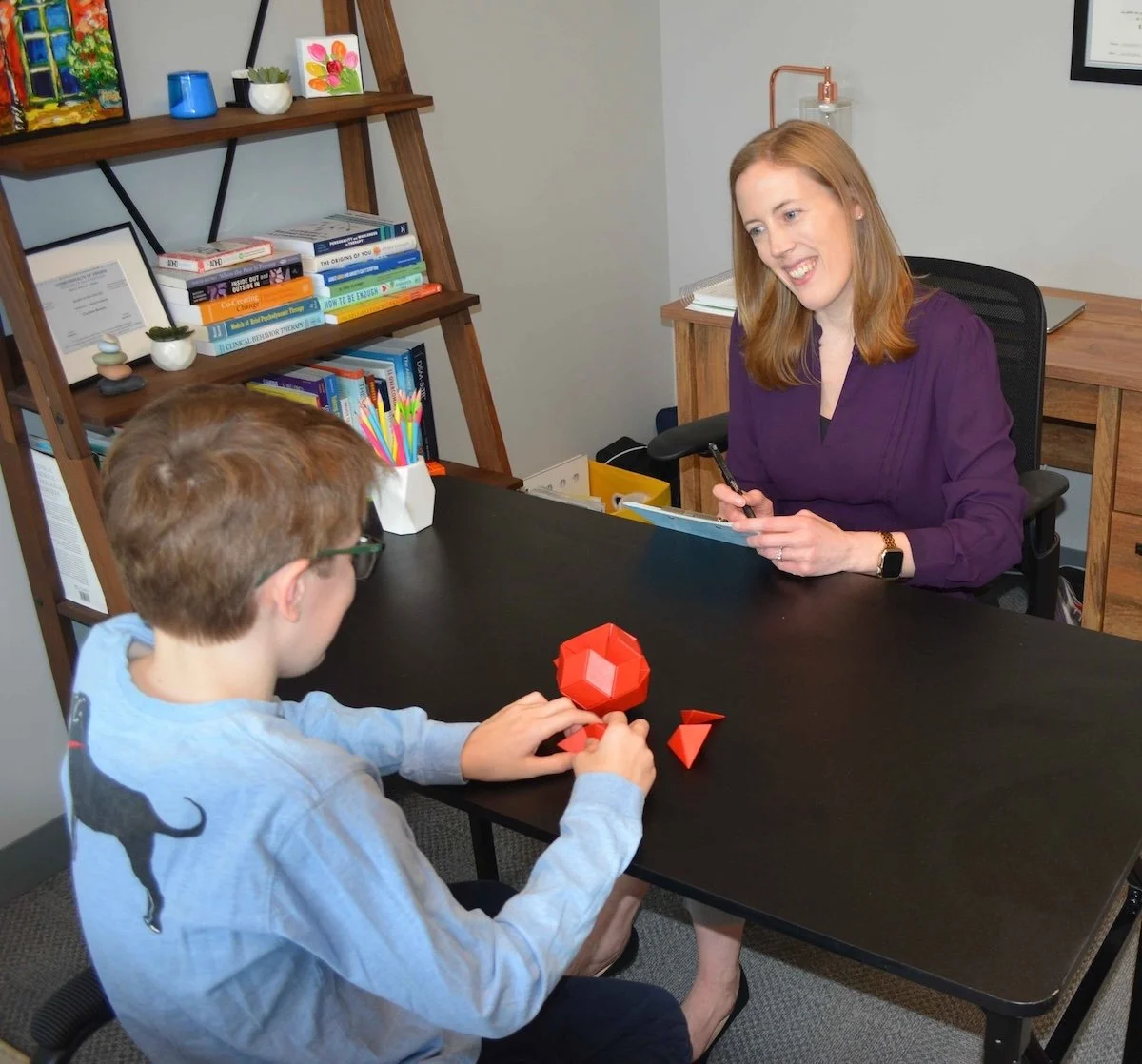
Your child will have one or two testing sessions with me. I will make each session as comfortable (and fun!) as possible. Testing includes many different activities, such as solving puzzles, drawing, answering questions, and learning new information. We'll also spend time talking so I can get to know your child. Younger children often enjoy the one-on-one attention and variety of activities. Teens often appreciate learning how their brain works and discovering what they're naturally good at.
3. Feedback Session & Written Report
This is where everything comes together. During the 90-minute feedback session, we'll review your child's results and I'll explain their strengths, challenges, and any diagnoses. I'll also talk you through exactly what your child needs, including recommendations for treatment, tutoring, or other kinds of support. I'll explain how to help them at home and at school. You'll leave knowing what to do next.
That same day, you'll receive a comprehensive written report with all test results, diagnoses, and recommendations. You can share this report with schools, colleges, or treatment providers to help your child get the support and accommodations they need.
At the end of the evaluation, you'll have clarity about why your child is struggling and a clear plan for how to make it better.Why clients choose to work with me
01
WARM
I create a supportive, low-pressure environment so your child can feel comfortable and do their best.
02
personal
You and your child will work directly with me from start to finish. I don't delegate testing to students or technicians. You get my full attention and expertise throughout the entire process.
03
thorough
My evaluations go beyond identifying challenges. I take the time to discover what your child or teen is genuinely good at and understand the reasons behind their difficulties.
04
responsive
I return messages promptly and keep you informed throughout the process. You'll never be left wondering what's happening or what comes next.
you don't have to figure this out alone.
Psychological testing can give you the clarity you’re searching for and a roadmap to help your child thrive.
Questions?
FAQs
-
You don't have to figure this out on your own. Start with an intake session. This 90-minute conversation gives us time to discuss your child in detail. I'll share my thoughts on what might be going on and whether I think testing would help. If we decide to move forward, I'll recommend the evaluation that best fits your needs.
The intake session fee is $400. If you proceed with testing, this $400 applies toward the total evaluation cost.
Many parents aren't sure at first whether testing is needed or which type of evaluation would be best. The intake session is designed to help you make an informed decision. There's no pressure to proceed with testing if it’s not the right step.
-
An evaluation can provide the documentation needed to request accommodations through a 504 plan or IEP, but the school makes the final decision about eligibility. My comprehensive reports include:
Clear diagnostic information
Specific recommendations for accommodations
Documentation that meets school district requirements
I write reports using language that schools in Fairfax County, Loudoun County, Arlington, and other Northern Virginia districts recognize and accept. Many families have successfully used my evaluations to secure accommodations like extended time, breaks during tests, preferential seating, and assistive technology.
For teens and college students, my evaluations provide the necessary documentation for SAT/ACT accommodations, college disability services, and graduate school entrance exams.
-
Many of the teens and college students I evaluate have had challenges for years but never received a formal evaluation. Often, parents tell me they had a nagging feeling something was going on, but the challenges were subtle enough that they kept wondering if testing was really necessary. As their child moved into high school or college, those challenges became more noticeable, made it harder to keep up with schoolwork, or started affecting grades and self-confidence. Sometimes the student noticed that something was different and asked their parent if they might have a learning or attention challenge.
It’s never too late to get answers. Testing can help in several important ways:
Getting accommodations and documentation: Testing provides the necessary documentation to request accommodations on standardized exams, like the SAT and ACT, and in college classes. My reports meet the requirements of the College Board, ACT, and college disability services offices. Common accommodations include extended time on exams, breaks during testing, note-taking support, reduced course loads, and quiet testing environments. For students who plan to attend graduate school, an evaluation can provide documentation for accommodations on exams such as the GRE, LSAT, and MCAT.
Getting the right services and supports: Testing reveals what kind of help will actually make a difference. For example, teens and college students with learning disorders can greatly benefit from evidence-based tutoring that targets their specific challenges. Students with ADHD can benefit from therapy, coaching, or medication. With a clear diagnosis, you know which treatments and interventions are likely to help.
Understanding and self-advocacy: Testing helps teens and college students finally understand their strengths and challenges. Students who struggle without knowing why often blame themselves or think they're not smart enough. Learning they have ADHD, dyslexia, or another difference is often a relief because it explains why certain things have always been harder. With this understanding, they can stop the self-blame, develop effective strategies, communicate their needs to professors or advisors, and feel more confident in their abilities.
The evaluation process for teens and college students is similar to the process for younger children, but I adapt my approach to be age-appropriate. Older students are actively involved in the intake and feedback sessions and in developing recommendations that fit their lives.
-
Yes. Psychological testing is the most thorough and accurate way to diagnose ADHD, learning disorders (like dyslexia, dysgraphia, and dyscalculia), and autism. I provide thorough evaluations that go beyond checklists or brief screenings. A psychological evaluation gives you an accurate diagnosis and a detailed understanding of your child’s strengths and needs.
-
I'm an out-of-network provider, which means I don't bill insurance companies directly. However, many families are able to get some reimbursement through their out-of-network benefits. I provide detailed receipts (called superbills) that you can submit to your insurance company for reimbursement.
You can also use your Health Savings Account (HSA), Flexible Spending Account (FSA), or Health Reimbursement Account (HRA) to pay for testing.
To find out if your insurance covers out-of-network psychological testing, call the number on the back of your insurance card and ask about your out-of-network mental health benefits for psychological testing (CPT codes 96136/96137: Test Administration & Scoring and 96130/96131: Psychological Evaluation Services).
-
The fee for each type of evaluation is listed below. Each fee covers everything involved in the evaluation, including an intake session, 1 or 2 testing sessions, a comprehensive written report, and a feedback session.
Psychoeducational Evaluation - Assessment for ADHD and learning disorders: $3,800
Social-Emotional Evaluation - Assessment for autism and mental health conditions: $3,800
Comprehensive Psychological Evaluation - The most thorough assessment - Assessment for ADHD, learning disorders, autism, and mental health conditions:
Ages 5-17: $4,500
Ages 18 and up: $4,500 to $5,000 (depending on complexity)
Many families are able to get reimbursement through their insurance plan’s out-of-network benefits. See "Do you take insurance?" for more information.
-
Frame it positively and emphasize the benefits: Start by explaining that everyone has unique strengths and areas where they need a little extra help. You can say something like, "Everyone has things they are really good at and things that are harder for them. Testing will help us understand all of your amazing skills and talents so we can focus on those. Testing will also help us (or your teachers, tutor, or therapist) find ways to make school less difficult and more fun for you."
Acknowledge their feelings: If your child is already aware of some of their challenges, validate their experience. For instance, "I know reading can be tough for you, and that's okay. We're going to do some testing to understand why it's hard and find ways to make it easier."
Prepare your child for what to expect: Explain when the sessions will take place and how long they will last. You can say, "You'll be meeting one-on-one with Dr. Howard, who is like a teacher. You'll be doing a lot of different activities—some will be fun and interesting, and others might be a bit challenging. That’s ok because each activity will only last a short time." Let your child know they can also talk about themselves, including their friends, feelings, likes, and dislikes.
Encourage questions: Let your child know they can always come to you with concerns, and they can ask Dr. Howard anything during their testing sessions.
-
I work hard to make testing comfortable and low-pressure. Many children actually enjoy the one-on-one attention and the variety of activities. Here's how I help:
I start each testing session by talking with your child about their interests or things they enjoy. Spending time getting to know each other before starting the tests helps kids feel more comfortable.
I build in regular breaks and encourage your child to ask for breaks when needed. During breaks, I offer activities for your child to choose from, such as talking, playing with the toys in my office, playing catch, drawing, or simply sitting quietly to read.
For children who need movement breaks, we can move around in my office or do a few laps up and down the halls.
If your child tends to have test anxiety or feel nervous in new situations, let me know during the intake session. I’ll ask you questions to find out what helps your child feel most comfortable, and I’ll adjust my approach as needed. Most parents are pleasantly surprised by how much their children enjoy the testing sessions.
-
Yes! I find it very helpful to collaborate with other professionals. With your written permission, I can communicate with teachers, tutors, therapists, or other providers. Just let me know during the intake session who you'd like me to contact, and I'll coordinate with them.
-
The report belongs to you, and you decide who sees it. I cannot share the report without your written permission. During our feedback session, we will review everything together privately before you decide what to do next. You can share the report with everyone, no one, or select people. It's entirely up to you.
Common ways parents use the report:
Share it with schools to request services or accommodations.
Use it to request accommodations on standardized exams, such as the SAT and ACT.
Provide it to therapists or psychiatrists to inform treatment.
Give it to tutors to help make tutoring sessions as effective as possible.
Keep it private and use the insights yourself.
I'm here to support whatever you decide.
-
The first step is to contact me for a brief phone consultation. During this 15-minute call, we'll discuss your concerns and I'll answer any questions you have. This helps us both determine if I'm the right fit for your child's needs.
You can reach me at:
Phone: 703-263-8339
After our phone call, if we decide to move forward, we'll schedule your intake session.